Lost Trails
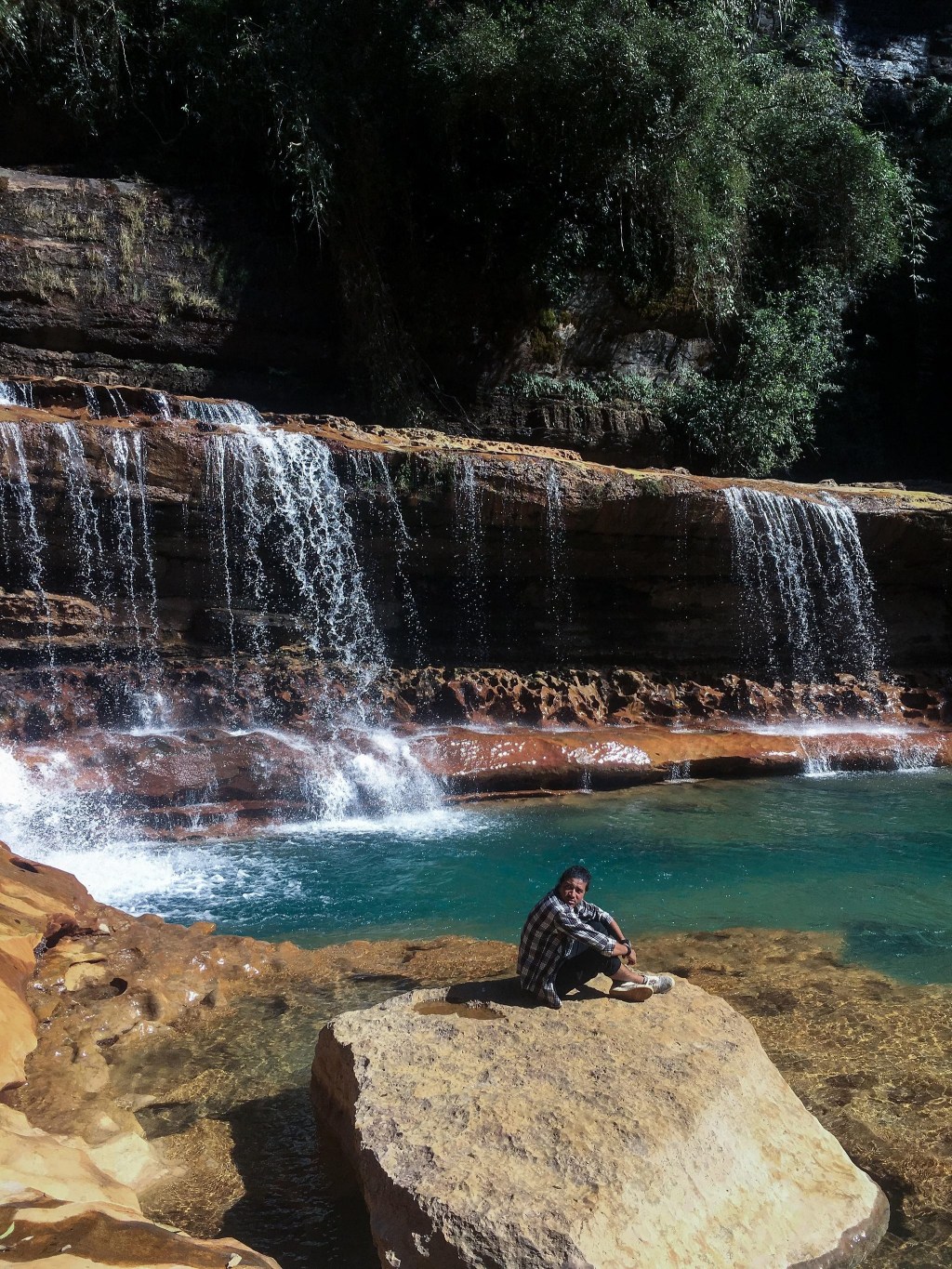
(Photo Caption) Michael poses for a photograph near a waterfall atop Nohkalikai Falls in Meghalaya, 2018.
A ninety-kilometre drive from Guwahati, Meghalaya— the abode of clouds, the Scotland of the East —has been a weekend gateway for friends and family since the nascence of my green memories. I remember Dad driving us to Umiam Lake in our Maruti Van, through the curls and fog, for the windburn. Umiam Lake, also known as Barapani, sits about fifteen kilometres before Shillong: slopes clad in pine trees, and islands scattered across its surface, an artificial reservoir born in the 1960s when the Umiam River was dammed for the region’s first major hydroelectric project. The Khasi community legend recites Umiam as the water of tears, echoing a legend of a heavenly sister whose grief satiated the gorge.
Anyway, the van, a maroon eight-seater, was bought by my father for plenty of people to hop in and celebrate. Strangely, it always ended up being the four of us—ma, baba, bhai, and me. I would kneel on the seat, peering at my parents in the front, looking through the windshield, chattering endlessly until my legs grew weary. Then, as the road curved sharply uphill, I would tumble from Newton’s law of inertia onto my brother, and our silly fights would engender
*
Back then in 2005-2006, roads were not arrayed like they are now—there was a certain thrill as a child, both joyful and anxious. Deep gorges on both sides of the road, and accidents for some reason caused a stir—perhaps because it was dangerous. And there were trucks, humongous trucks, overloaded with coals, lined one after another. Landslides were common and boulders split from the mountains whenever the weather found it easy, and the rocky mountains on one side of the road were marked with white chalk.
Pineapples and pickles were often the excuse for our short drives. Pineapple, in fact, is one of Meghalaya’s most important fruit crops, covering roughly ten thousand hectares and contributing around 8% of India’s total pineapple production, with Ri Bhoi and West Garo Hills among the major producing districts. I believe I learnt wilderness from those travels. Back then, we didn’t need to drive all the way to Shillong for the windburn—the cold breeze would salaam us at the foothills. The road always felt strange. I was always afraid and anxious, convinced an accident was waiting to happen, or that the ghosts of those who died in the mountains would chase us and curse the axle of our car. Strangely, we were never tourists. My father loved to drive, so it was always a getaway—up and down the winding roads, while I sat by the window, staring endlessly at the world outside, mulling in silence.
*
When I finally grew up and collated years of societal and familial repression, I turned into a rebellious, restless soul—angry and defiant. I travelled in torture: with no money, on rickety buses, with a camera hanging from my neck, poetry, torn shoes, cigarettes, and half-lit weed joints. Those who journeyed with me never did so twice. And still, I was never satisfied. I longed to hitchhike, ride on bus roofs, and travel in trucks. In the end, it was always about the experience. I craved the raw, unfiltered essence of an event. Perhaps that’s why I execrated luxury; it felt like chasing five-star hotels, fine dining, and infinity pools stripped travel of its soul. Though today, I wonder if that was judgmental. We create strange narratives and biases to comfort ourselves in the spaces where we feel separated. And when we grow too comfortable with those separations—that’s where prejudice begins.
Much of my college days were spent uncovering hidden pockets of Meghalaya. I had this strange intuition—a call, almost—a knack for discovering places, long before they had become tourist hotspots or went viral on social media. You’d be stupefied by how I chose those destinations: I would open Google Maps, follow a random impulse, and then pack my bags. Often, these journeys were riddled with misfortunes, yet they led me to gems that were untouched and unknown at the time.
Even now, I carry a silly, imminent urge to live like Christopher McCandless—the protagonist of the novel titled ‘Into the Wild’ by Jon Krakauer. Perhaps it’s a romantic idea, but its allure remains undiminished in my imagination for some reason—a life in the wilderness, raw and unfiltered. It feels perfect: the story, the plot, the passion, the discovery, the realisation, the romanticisation, and the profound relationship with everything around. And yes, even the tragic ending—dying by the most unforgiving means possible: hunger and the Arctic cold. It was as if I was seeking, hoping to tear a crack in my chest to widen the wound, for the light to enter, for love to find its way into me, and somehow redeem myself from all the thoughts that never seemed to forgive me even once in an hour.
*
In 2018, I travelled to Kongthong village, known as the whistling village, because the natives name their children with a unique tune, used for communication, like a pet name to summon them from the fields. Kongthong is a small hill village in the East Khasi Hills district of Meghalaya, about 60–65 km from Shillong, with a population of a little over 500–700 people. This whistling tradition is called Jingrwai Iawbei, meaning melody in honour of the root ancestress. The mother composes the baby’s tune as a lullaby, and it becomes the person’s lifelong identity.
In Kongthong village, I came across a woman feeding her baby while softly whistling a lullaby—a melody that would become a lifelong memory for the child. Women form the backbone of the Khasi community, which follows a matrilineal system where descent and clan identity are traced through the mother’s line. Yet, political and panchayat leadership remains with men, so the system is not truly matriarchal as opposed to patriarchal. In Khasi tradition, ancestral property is inherited by the youngest daughter, known as Ka Khadduh, who bears the responsibility of caring for ageing parents and supporting siblings. If there are no daughters, a girl may be adopted to continue the lineage. The Khasi system is also matrilocal, meaning the husband moves into the wife’s home after marriage. Rooted in these customs, the birth of a girl is often celebrated with pride.
In Meghalaya, the major tribes of the state are the Khasi, Jaintia and Garo–that recognise the mother’s line as the core of the clan. This stands in sharp contrast to much of patriarchal India, that neglect of girls to son preference, the belief that only sons can perform last rites, and holds the idea that lineage and inheritance ‘run through the male line.’ This demographic effect is visible in the numbers: as per Census 2011, Meghalaya has one of the highest child sex ratios in the country at 970 girls per 1,000 boys aged 0–6, while Rajasthan (888), Maharashtra (894), Uttar Pradesh (902) and the National Capital Territory of Delhi (871) all show more skewed ratios. The official crime data tell a similar story of contrast: in 2022, Meghalaya recorded 690 cases of crimes against women, compared with 45,058 in Rajasthan, 45,331 in Maharashtra, 14,247 in Delhi, and 65,743 in Uttar Pradesh, according to state-wise figures compiled by the National Crime Records Bureau.
*
After a brief stay in the village, Michael—whom I met at the Shillong taxi stand and befriended—decided to trek to a living root bridge and swim in one of its waterfalls. Hunger struck us midway, as I hadn’t realised how challenging the trek would be. That’s when we stumbled upon an old woman camped on the edge of a mountain ridge, surrounded by silkworms and strange insects she bred inside her tent. She lived with them. Michael, ever the quick thinker, declared this our moment in the wilderness—and so we sat with her, sharing a silent feast of insects. Later, on our way, Michael drank from a stream born of a waterfall, and I followed his lead. Finally, we perched on a massive rock overlooking mountains and a gorge so deep it blurred my vision. There, we smoked a cigarette while I carefully plucked the tiny hooked hairs of goose-grass clinging to my clothes.
I spent the first two nights in a cheap hotel, somewhere in Upper Shillong. It was a small room without windows, and the lodge officials charged me three hundred rupees per night. The bathroom was stinking, and so on my third night, I had to change my room. On the fourth morning, we decided to trek to the mouth of the tallest plunge waterfall in India—NohKaLikai Falls. This trek is impossible during the monsoon or when the waterfall is flowing with cusecs of water downstream. From the gorge of the fall, trembling, I took a picture using a tripod. The bed consist of numerous sinks or holes that are filled with water, and one can dive into those holes and swim and come out of other holes located in the same bed at the mouth of the waterfall. I dived once or twice but thought it was too dangerous to swim from one sink to another—fearing I might be lost underground. Instead, we found a small reservoir, where we bathed in the harsh sun and swam. I remember Michael making fun of my swimming techniques, and we took many photographs.
*
From the mouth of the waterfall, we made our way to a sacred forest nestled in Mawphlang village, about 25 kilometres from Shillong. The Khasi word Mawphlang combines two words—Maw, meaning stones, and Phlang, meaning grass. Mawphlang is renowned for its Sacred Grove (often called Mawphlang Sacred Forest or Law Lyngdoh/Lawkyntang), one of the oldest and largest sacred forests of the Khasi people, with a cultural history spanning more than 800 years. Local belief holds that forest spirits or deities—often referred to as U Basa, U Ryngkew, Labasa, or Ryngkew Basa—protect the grove and the surrounding community, acting as guardians of the land.
A section of the forest has been opened for tourists to trek and immerse themselves in these traditions, marked by monoliths, natural swings formed by tree roots, and strict advisories against harming the forest. I have visited Mawphlang several times, and on one occasion, during a rainy day, I was barred from entering. Locals explained that heavy monsoon rains had eroded the topsoil, exposing the vulnerable roots of many trees, and that the trek was closed to prevent damage to the trees. But with Michael, luck was on our side—we even hired a local guide who became our wayfarer.
I photographed various medicinal trees and shrubs as the guide explained their uses. Among them was the English yew, an ornamental evergreen of the yew family, with spreading branches and drooping branchlets. It grows wild in the forest and is valued for its medicinal properties—used to treat respiratory ailments like asthma and bronchitis, and for its anti-cancer compounds in chemotherapy. Traditional remedies also employ it for headaches, kidney disorders, and rheumatism, though all parts of the tree are highly toxic and cannot be ingested.
By afternoon, we clung to a hanging branch like a rope and took photographs of ourselves swinging like Tarzan. The guide stayed with us all day, singing tunes as we followed along. By the end of the trip, it turned out to be one of the best times I’ve ever had—largely because of Michael and the strange, fast friendship we forged over random conversations in his old, rickety Alto. He said, “I drive cars, but this is not my profession. When I found out you make photographs, I thought you would be one of those adventurous types. So, I said yes to travel with you.”
*
That year, I faced many dangers to travel for a person suffering from social anxiety disorder to get out of the van that my father and mother built for me to keep me safe, and plunge onto the road seeking destruction of those after-images and after-thoughts, much like William Wordsworth.
Today, I am no longer afraid of the roads of solo backpacking, and it reminded me of the lines penned by Wordsworth of this experience on visiting the banks of the Wye as a child who, for the thrill and adventure, rows a boat and that stealthy act turns to anxiety when a massive, dark mountain peak appears, seemingly pursuing him. This traumatic experience deeply affects him until adulthood, when he confronts the conflict in his adulthood. I believe my travels are often based on such traumatic conflicts within. Steven Knapp, in his essay titled ‘The Sublime, Self-Reference and Wordsworth’s Resolution and Independence ‘, summarises the sublime (transcendent sublime) as a mental space of unresolved experience/conflict appearing in repetitions as an after-image, but injected with the possibility of an action someday but not yet acting, but thinking of certain equations, towards a journey of resolution that will bring liberty and freedom.
*