Sisters of the Garden
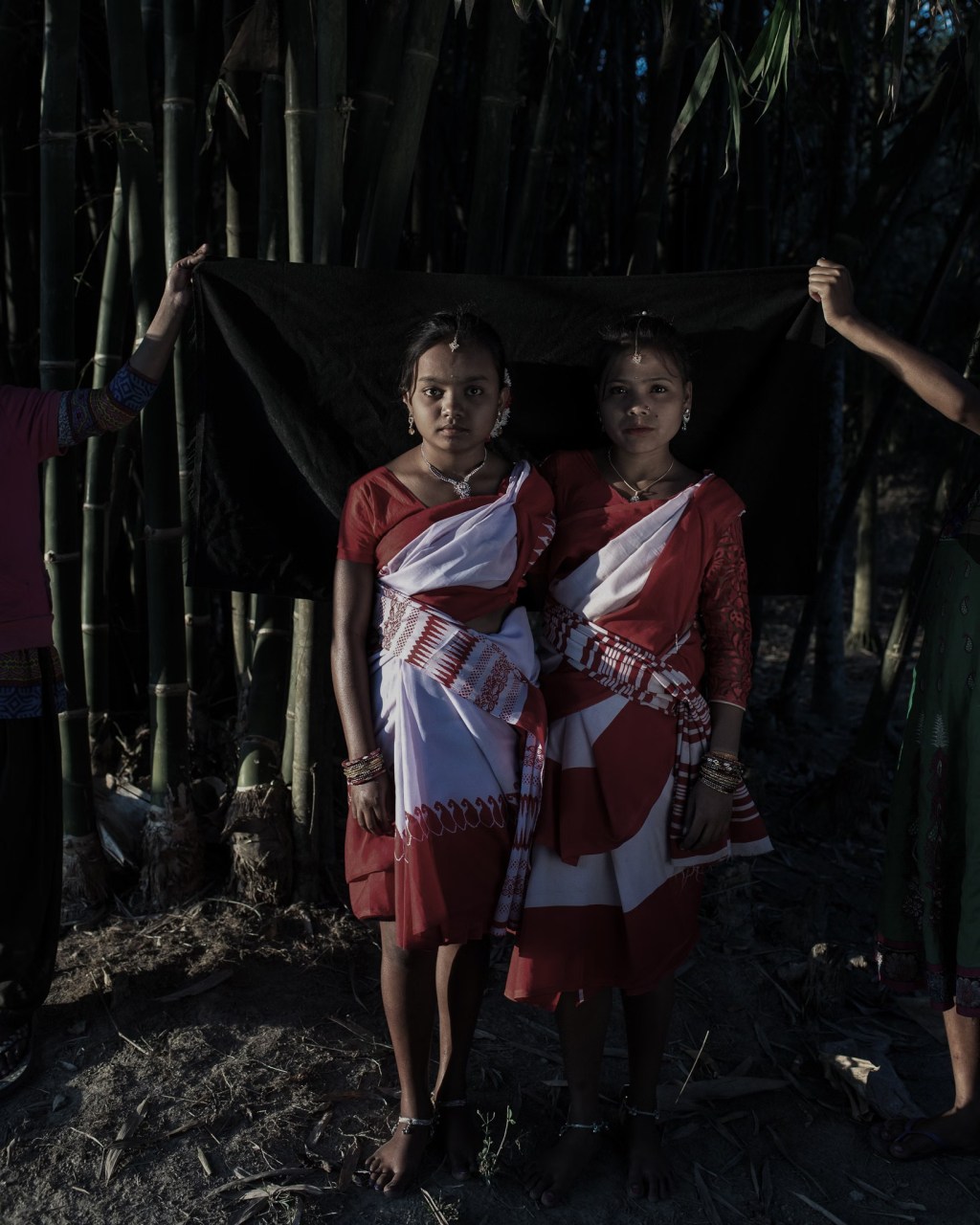
(Right) Girls belonging to the tea tribe community, dressed in their traditional attire, pose for the photographer in Jorhat district, Assam, India
In a 1994 Paris Review interview, Chinua Achebe remarked, “If you don’t like someone else’s story, write your own.” True to this conviction, Achebe devoted his craft to narrating the colonial experience from the colonised perspective.
In his seminal novel Things Fall Apart, Achebe explores the disintegration of cultural identity as traditional Igbo society confronts the arrival of British missionaries and their civilising mission to “educate savages.” This encounter triggers profound socio-cultural and religious upheaval, forcing a community into an arduous journey of assimilation—accepting a new God, new beliefs, and a foreign language. Achebe masterfully weaves Igbo proverbs and expressions into English prose, using the coloniser’s language to reclaim dignity and counter the false narrative that African societies lacked language or culture. Yet, within this world, Igbo women remain bound by an oppressive, patriarchal order—portrayed as enduring violence and silenced, their voices scarcely heard.
The tea industry is among India’s oldest and most organised sectors, playing a pivotal role in the nation’s economic development. Renowned globally for its quality, Indian tea owes its reputation to favourable geography, substantial investment in processing units, continuous innovation, and strategic market expansion. The industry traces its origins to the discovery of indigenous tea bushes in the Mishirni Hills of Upper Assam in the Brahmaputra Valley by British colonisers, notably Robert Bruce. Assam, celebrated for its sprawling tea gardens and lush greenery, has become emblematic of the region’s identity. However, this legacy was built on the exploitation of cheap labour—workers forcibly relocated by the British from Jharkhand, Odisha, and Bihar to Assam. Today, these tea-tribe communities constitute nearly 20% of Assam’s population, granting them significant electoral influence. Yet, despite being courted during campaigns, their aspirations are repeatedly betrayed, leaving behind a deep sense of anger born from broken promises and systemic neglect.
I observed that women within the tea-tribe society are doubly oppressed—bound by both patriarchy and post-colonial structures—making them fit Gayatri Chakravorty Spivak’s narration of the subaltern. In her seminal essay “Can the Subaltern Speak?” Spivak argues that subalterns cannot speak for themselves within dominant frameworks of Western knowledge and power, as their voices are often ignored, co-opted, or silenced. Institutions claim to represent these marginalised groups but frequently impose their own agendas, overlooking internal complexities and hierarchies. Even the nomenclature of this community, defined by a commodity—tea—is an early marker of dehumanisation and systemic oppression.
Kolchi, a garden worker, shared that she wakes at 5 a.m., completes household chores, cooks for her family, and leaves by 8 a.m. to work in the tea gardens. Her husband, an alcoholic, remains largely unemployed—a reality echoed by many women in the community. Anita Tati confessed her fear of touching flowers in the garden, as her malik might penalize her with a salary deduction. Perhaps most striking is the story of 17-year-old Anjali (name changed), already a mother, who resignedly states: “This is my destiny. My mother worked here. I work in the gardens, and likewise will my children.” In 2016, women in these gardens earned ₹126 per day, paid weekly along with a ration. They were allotted small plots of land, which could be reclaimed if they—or someone on their behalf—failed to replace them during absences.
I reference Things Fall Apart here because the process of assimilation and transformation within a society is often a violent cultural upheaval marked by anarchy. The centre cannot hold, and the equilibrium of the community collapses. Consider seventeen-year-old Anjali, who identifies herself solely as a tea-gardener, or Anita Tati, who fears plucking flowers from the garden she tends. Such narratives reveal how hegemonic structures, rooted in colonial forces, perpetuate assimilation and embed themselves within cultural phenomena.
A few months after the 2016 Indian banknote demonetisation, I travelled to Upper Assam to explore the identity of the “tea-tribe community.” At Heelekah Tea Estate in Jorhat district, I encountered a group of women harvesting tea. I will be honest—I had just graduated from photography school, brimming with enthusiasm and ambition. I wanted to photograph the world and its communities; I aspired to be like Sebastião Salgado, the Brazilian Magnum photographer. Yet, on my first day in the garden, I was deeply unsettled by the question of representation.
I began observing clues—one of them being sisterhood. The women gardeners appeared like sisters to one another: they plucked tea leaves, married, drank lal chai, rode bicycles, and shared stories about their households, including the alcoholism of their men. They teased passersby, and by evening, some had their wages cut, some were scolded by men, and the same women whispered those secrets into the ears of others.
On the first day, I photographed everything. Yet these theories and questions kept me awake at night. I wanted my photographs to reflect the sisterhood I had witnessed—a celebration of their bond. At the same time, I was acutely aware that the camera, like the pen, is an apparatus of power; a careful deconstruction could easily expose the photographer’s lack of humanity toward the community. A photographer, like a writer, must access his subjects and, born from the subjectivity of the surrounding, strive for objectivity to arrive at a harmonic order. This is why the oft-quoted line—“Your first ten thousand photographs are for rejection”—never sat well with me; it removes thinking from the process. Thinking, I believe, is a critical part of photography.
Nevertheless, as a student then—and still a student ten years later—I overthought these things to the point of losing peace. But I was passionate. I wanted them to know that the camera could silence them without their knowing. There was no way I could explain this in their language without becoming a false prophet.
Again and again, I was reminded of Chinua Achebe and his insistence on writing from the perspective of the colonised. I wondered: what if I stopped worrying about representation and instead exaggerated misrepresentation? I carried a small rectangular black cloth, which I began using as a backdrop—a symbol of protest and activism for the community. Lacking equipment, I enlisted the tea garden workers themselves: two held the cloth, one managed the diffuser to direct light, and others searched for women willing to be photographed. Some returned home to dress in traditional attire, while another group scouted locations for the shoot.
Their active participation dissolved my anxiety about misrepresentation. That was the moment I decided to embrace this idea. For the next five days, I hired two local boys to carry my equipment, and together we cycled from one garden to another. We excluded all men from the process, and the gardens came alive with laughter, performances, and tea. I witnessed a beautiful sisterhood among these women—and an intimate relationship with the garden. It was as if the garden existed because of them, and they existed because of the garden.
 Manish Sharma